Service Dog Tasks and the Public Access Test, Explained
This page explains the law in general terms. It is not legal advice. For a specific situation, contact the agency listed on this site or an attorney.
Two ideas come up again and again in service dog training: the tasks a dog performs, and the public access test. People often mix them up, and they often assume the test is a legal requirement. It is not.
This guide explains what counts as a task, how to build a task step by step, and how to use a public access test as a training benchmark. It also covers what New Hampshire law says about service dogs.
The short answer: what counts as a task
ADA.gov says a service animal is a dog that has been individually trained to do work or perform tasks for an individual with a disability. The work or task must be directly related to the person's disability.
New Hampshire's definition is similar. RSA 167-D:1 defines a service animal as any dog individually trained to do work or perform tasks for the benefit of an individual with a disability. The statute covers physical, sensory, psychiatric, intellectual and other mental disabilities. It speaks only of dogs.
So when people ask what tasks a service dog can do, the legal answer is broad. Any trained action that does work for the person because of their disability can count. The training is what matters, not the breed, the vest or any paperwork.
Why comfort alone is not a task
Emotional support, therapy and comfort animals are not service animals under the ADA. A dog whose only role is to be present and soothing has not been trained to perform a task.
The line is not about how much the dog helps. It is about whether the dog has been trained to take a specific action in response to the disability. A dog that senses distress and calmly stays near its person is offering comfort. A dog trained to interrupt a panic attack by nudging or applying pressure on cue is performing a task.
Examples of tasks by disability
These are illustrations of the kind of work a dog may be trained to do. They are not a complete or official list, and each dog's tasks should fit its handler's actual needs.
Mobility disabilities
- Retrieving dropped items or fetching a phone
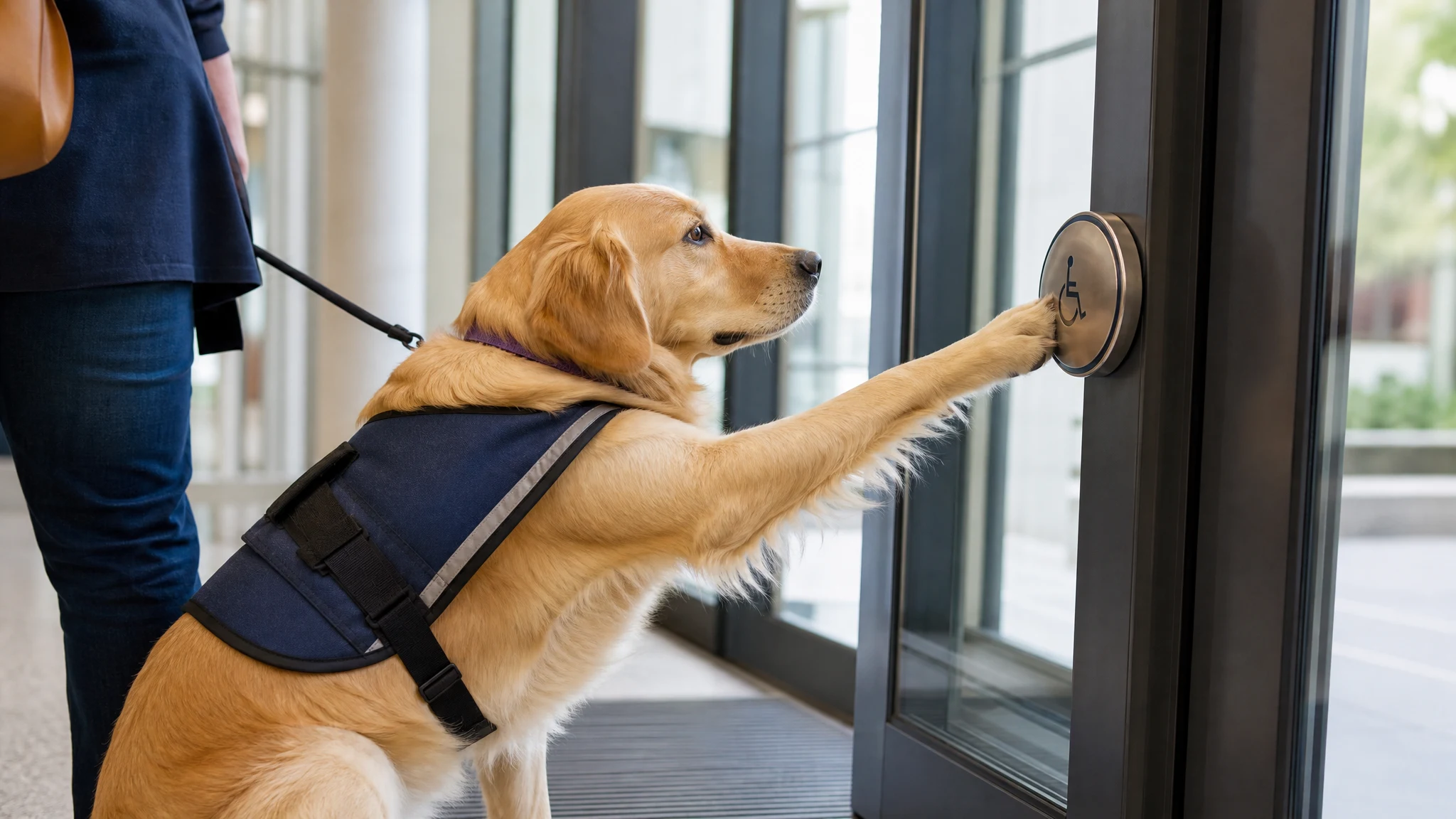
- Opening and closing doors or pressing accessible door buttons
- Providing counterbalance or bracing during transfers, when the dog is suited to it
Hearing loss
- Alerting to a doorbell, smoke alarm or a person's name being called
- Leading the handler to the source of a sound
Vision loss
- Guiding around obstacles and stopping at curbs or stairs
Psychiatric disabilities, including PTSD
- Interrupting repetitive or self-harming behaviors
- Applying deep pressure on cue during an anxiety episode
- Turning on lights or checking a room on command
- Creating space in a crowd by standing behind or beside the handler
Medical conditions
- Alerting to a change linked to a seizure or blood sugar shift, where the dog has been trained to do so
- Fetching medication or summoning help
Autism
- Interrupting repetitive behaviors
- Keeping a child from bolting, when trained to work with a tether and a caregiver
Some New Hampshire organizations list these kinds of work among the needs they serve. Little Angels Service Dogs in Bartlett lists autism, seizure alert, mobility, hearing, psychiatric, diabetic alert and medical alert work. Gilford's Golden Guardians Service Animal Training in Gilford lists medical alert, autism and PTSD support. Costs and waitlists for these groups are not stated on their sites, so contact them directly.
What you need before you start
Training a task takes few supplies. These are the basics.
- A written list of the disability-related needs. Start with what the handler needs help with, then choose tasks to match.
- Small, soft treats. Pea-sized pieces let you reward many repetitions without overfeeding.
- A flat buckle collar or a well-fitted harness. Choose equipment that is comfortable and does not cause pain. Prong, choke and shock collars have no place in this work.
- A six-foot leash. It gives control without tension.
- A clicker or a marker word. A short, consistent signal such as "yes" tells the dog the exact moment it got it right.
- A training log. Note the date, the place, the distractions and how the dog did. Handlers often find the log useful when they have to explain their dog's training later.
- A quiet starting space. A hallway or living room works well.
Step-by-step: teaching a task
This process follows the humane, reward-based methods endorsed by the American Veterinary Society of Animal Behavior (AVSAB). It avoids force, fear and dominance.
- Define the task in one sentence. Write what the dog does, what cue starts it, and how it connects to the disability. For example: "When I give the cue, the dog places its chin on my knee and holds it until I release." If you cannot link the action to the disability, it is probably comfort, not a task.
- Break it into small pieces. A retrieve becomes: look at the item, touch it with the nose, mouth it, pick it up, carry it, deliver it to hand. Train one piece at a time.
- Mark and reward the first piece. Click or say your marker the instant the dog does the behavior, then give a treat. Repeat until the dog offers it quickly.
- Add a cue. Once the dog reliably performs the behavior, say the cue just before it starts. Keep the cue short and distinct from words you use in everyday talk.
- Build duration, distance and difficulty one at a time. Change only one thing per session. If you add a new room, lower the other demands.
- Practice in the real situations the task is meant for. A medication retrieval should be practiced where the medication is kept. Alert training should use real or realistic triggers, with a qualified trainer's guidance where the task depends on a medical signal.
- Fade the treats gradually. Move from rewarding every repetition to rewarding some, but keep the dog's pay good. Praise, play and access to things the dog likes can all be rewards.
- Keep a record. Note when each task was first reliable and in which settings.
The public access test: a benchmark, not a law
A public access test checks how a dog behaves in public: whether it stays calm, ignores distractions and responds to its handler around people, food and other animals. Assistance Dogs International (ADI) has a public access standard that many programs use as a training benchmark.
It is not a legal requirement under the ADA. ADA.gov does not require a test, a certificate or any registration for a service animal. There is no official service dog registry. An online registration or ID card is not legal proof that a dog is a service dog, and nothing in this guide suggests you need one.
The same is true in New Hampshire. RSA 167-D does not condition access on passing a test. The state definition turns on individual training to do work or tasks.
So why use a test at all? Because the legal protection comes with an expectation that the dog is under control and behaves in public. A benchmark gives you an honest way to check whether your dog is ready. If you want to follow the current ADI standard, check ADI directly for the exact items and scoring, as they can change.
Skills worth practicing for public outings
These are general readiness skills that handlers commonly practice, whether or not they ever take a formal test. They are not a copy of any official test.
- Walking calmly on a loose leash through doorways and crowds
- Settling under a table or beside a chair for a long period
- Ignoring dropped food, other dogs and people who call to the dog
- Staying calm on stairs, elevators and slick floors
- Staying quiet and not soliciting attention
- Handling a task cue in a busy place
- Staying clean and comfortable with handling
What New Hampshire law says about access
RSA 167-D:4 gives a service animal the right to accompany its handler or trainer into any public facility, housing accommodation or place of public accommodation open to the general public. The right is subject only to conditions that apply alike to all persons. RSA 167-D:8 makes it unlawful to prohibit, hinder or interfere with the handler or trainer.
Under the ADA, when it is not obvious that a dog is a service animal, staff may ask two questions. First, is the dog a service animal required because of a disability? Second, what work or task has the dog been trained to perform? Knowing your dog's tasks and being able to state them plainly in a sentence helps with the second question.
For dogs in training, the state statute treats a "service animal trainer" as having the same access rights and responsibilities during the actual training process. That covers employed or volunteer raisers for providers, individuals helping a person with a disability train their own dog, and trainers testing eligibility for the New Hampshire tag. Read the details in our guide to service dogs in New Hampshire, including training and access rights.
RSA 167-D:8 also makes it unlawful to fit an animal with service animal gear or a tag when it is not a service animal, or to impersonate a person with a disability to obtain service dog accommodations. RSA 167-D:10 says violating the chapter is a misdemeanor. The sources reviewed did not list a specific fine or jail term, so check the current statute for the penalties.
Tips and common mistakes to avoid
- Mistaking comfort for a task. If the dog is only present, it is not a task. Train a specific action tied to the disability.
- Believing a certificate makes a dog legal. Under the ADA, no certificate or registry exists. Spend that money on training instead.
- Rushing into crowded places. Build up from quiet spaces. A dog that is overwhelmed learns the wrong lessons.
- Using harsh tools or corrections. Fear-based methods can damage the dog's trust and its willingness to work. Stick with rewards.
- Training too many things at once. Get one task reliable before adding the next.
- Ignoring the dog's welfare. Watch for stress signals such as yawning, lip licking, panting or avoidance. End the session or lower the difficulty when you see them.
- Skipping the veterinary check. Some tasks, such as bracing, put strain on the body. A veterinarian can advise on whether your dog is physically suited to the work.
Expected results
Progress varies a great deal between dogs and tasks. With steady, reward-based practice, many handlers find that a simple task can become reliable at home within weeks. Public settings usually take longer, and complex or alert-based work can take much longer, so timelines should not be treated as promises.
A public access benchmark may help show where a dog is solid and where it needs more work. It does not predict how a dog will behave on every day, and it may not match what a store, workplace or housing provider expects. Some dogs may turn out not to enjoy public work. Ending a dog's service career when it is not comfortable is a responsible choice.
If you are denied access
This guide is not legal advice. If you believe your rights were violated, you can contact the New Hampshire Commission for Human Rights at 57 Regional Drive, Suite 8, Concord, NH 03301, or (603) 271-2767. It enforces anti-discrimination law in employment, public accommodations and housing. Confirm with the agency whether it takes service animal access complaints, and what its process is.
For federal questions, ADA.gov's service animal FAQs set out the rules.